
Enormous Wings, by Laurie Frankel
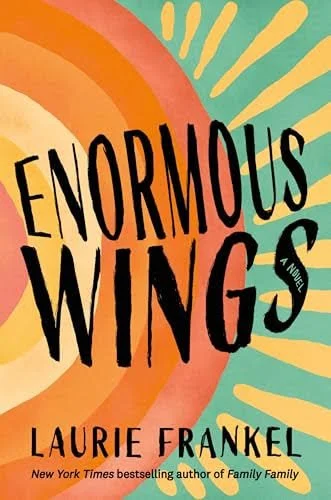
Pepper Mills, a divorced, seventy-seven year-old retired high school English teacher, winds up in the Vista View Retirement Community, an assisted living facility, where her three adult children place her after she loses her driver’s license by rear-ending an Episcopal minister named Father Frank. Her kids found this place a couple of years ago, when they placed their father, Pepper’s ex, here. Pepper takes the loss of freedom in stride, which seemed odd to me, but she may have been happy about the newfound friends after years of living alone. Frankel nails the whole assisted living vibe—silly classes, chair yoga, local trips in the van, bad food, emergency pulls in all the rooms, corridors lined with handrails—efforts to make an institution look like a cozy home, and just failing, a bit. Pepper makes friends, then a friend with benefits, and this is where the story really starts. Because quite amazingly, Pepper becomes pregnant.
Frankel has two social issues to tackle in this novel: how we think about and treat aging people, and child bearing, in general. By creating this extraordinary situation, she uses Pepper, her encounters, how people react to her, try to use her, what she symbolizes—as a device for this examination. Frankel often goes well into absurdity, depicting both pro-life and pro-abortion factions as caricatures. What proves more effective is the idea of an older person as pregnant. People routinely see older people and avoid contact—they often speak too loudly, can’t hear or understand what is happening, might smell bad, move slowly, need more time and patience. Most people don’t have the patience or tolerance for this. Now add how society treats pregnant women—their bellies become public property, as strangers feel free to touch and comment upon them, without reservation or consideration. Put these two conditions together in one person, and you can see the confusion, and readiness to use Pepper for whatever agenda or assumptions people may have.
Pepper ping-pongs off of each encounter, all while trying to arrive at decisions with her doctors on the best, healthiest way forward. This is where discussions about child bearing and parenting come in—when is the best time for this? Is there ever a best time? How do we decide such a momentous change in our lives? Contraception went from giving women freedom to creating an enormous burden, trying to decide something for which there really is no good answer. For can any of us really say there is a good or bad time for a baby? The longer we live, the more stories we learn of babies born into “bad” circumstances who were the greatest blessings, to the parents and society. Also, babies born into “perfect” situations who had to deal with a lack of love, or changed circumstances. For all babies require, truly, is selfless love—love that is willing to make them the center of the world, to give them the care, time, and attention to nurture them into childhood. They are a blessing, a challenge, a burden—and an opportunity for love.
Frankel has stacked the deck, since her main characters all believe in the right for a woman to choose to terminate the baby’s life. Someone even comments that the pregnancy isn’t even a baby, barely even a fetus, in the early weeks. While activists on both sides are depicted as a little crazed, the pro-lifers are seen as incoherent and violent. That is unfair, as Catholic protesters quietly walk and pray, without holding signs, not approaching or talking to women coming for procedures. Even the annual March for Life in Washington, DC is the most peaceful demonstration imaginable. If Frankel could have been unbiased in her point of view, this would have been a more effective novel. Nonetheless, I appreciate her attempt to creatively place these issues before the reader, in a funny parody. I find sometimes authors hold a particular view, and don’t realize the bias reduces the novel’s effectiveness, making for a lesser impact.
Enter this novel knowing the author’s bias, but appreciating the attempt to parody and examine issues of aging and abortion. It could have used tighter editing too, as some run-on sentences are sort of incoherent. Recommended.