
Taipei Story, by R.F. Kuang
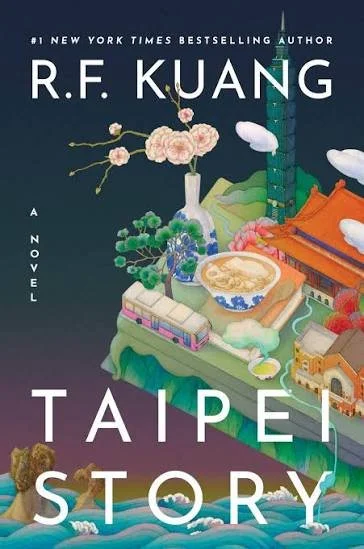
Rebecca Kuang was a prodigy, writing and publishing novels since she was a teenager. Meanwhile, she graduated high school, got an undergraduate degree at Georgetown, got master’s degrees from Cambridge and Oxford, is earning a PhD from Yale, and teaches at Holy Cross. She has written the phenomenal book Babel (https://www.margueritereads.com/home/babel-or-the-necessity-of-violence-an-arcane-history-of-the-oxford-translators-revolution-by-rf-kuang?rq=kuang), and the hilarious, snarky novel Yellowface (https://www.margueritereads.com/home/yellowface-by-r-f-kuang?rq=kuang) during that time. Each time she seems inspired by something happening in her life, using that as a jumping-off point, picking a different genre each time. It is as though she has a personal challenge to write in various genre, whatever is appropriate for the story she wants to tell.
At thirty, she is finally looking back for inspiration, to her younger self, as an undergraduate visiting a foreign country, during a summer intensive language program. While Kuang says this is not autobiographical, it has strong parallels with her own biography. She takes her naïve protagonist, Lilly, a Yale undergrad fresh from completing her first year, taking Yale’s Mandarin immersion program at National Taipei University in Taiwan. Lilly has the personal assumptions many smart, academically ambitious young people have—anything that they throw their mind at with enough discipline and persistence can be mastered. As she learns, language acquisition does not conform to this—there is an optimal time to absorb the nuance, and it is terrifically hard to gain that mastery through effort as an adult. As Lilly complains, she is working so hard to learn what her parents learned as little children, effortlessly. Since her academic performance is central to her self-image, this is a great blow.
Lilly is attempting to reach back to experience the culture of her parents and grandparents, who were from mainland China. Although she was born there, they moved when she was a young girl, so she remembers very little. She opted for the program in Taipei, rather than Beijing, since Taipei was the more rigorous, superior program, and fully funded by donors and the school. The cultural experiences she has in Taipei are not really even close to what her elders experienced, especially since time has changed so much. Lilly always held out hope that she would learn the language, then be able to sit down with her grandparents, and ask all the questions about their lives she now has. As a child and teenager, these concerns were not at all on her radar. Suffice to say, life doesn’t conveniently go according to our plans, and this becomes a novel of how a young adult handles grief and loss for the first time.
Given China’s complicated history of war, civil war, dictators, nationalism, and colonization, it is not easy to slip back and have an authentic feel for the lives of her forebearers. The generational differences are great, the world is different, something that young people don’t realize readily. Lilly is learning so much more than language. Don’t think that this book is morose, however. There are many funny scenes, misunderstandings related to language and culture, Lilly’s observations of fellow travelers and students, all navigating unfamiliar situations with amusing posturing. The one bit that seemed weird to me was an overnight trip she takes to a hot springs resort town with the fellow Yale hot male student. How could Lilly not realize that JC was looking for a quickie with her? He conveniently makes sure her roommate wouldn’t be able to go, leaving the two of them in a double bed for the night. Lilly is such a driven academic, she really has not much experience physically, and treats the encounter like academia—simply apply knowledge, observation, and effort. The fact that she isn’t appalled by his presumptiveness, or even so naïve as to not realize what would be expected, is just weird. When JC proves to be a gossip, spreading rumors to hurt her reputation among the students, it seems a bit of an unnatural plot contrivance. Nonetheless, it gives Lilly the space to explore her own Taipei, apart from the confines of the program.
Apart from that forced plot element, this novel is an entertaining and sensitive look at the experience of trying to explore and understand our roots, from a young person’s perspective. It is like trying to understand a different world—you cannot go back and see it, since it no longer exists. There were probably good reasons why so many left, and much is changed now anyway. This is true for anyone trying to reach back and experience their heritage, but especially so for the Chinese diaspora. This part of the world has changed tremendously in one or two generations, the language and culture are complex, and sharing the same DNA is not enough to bridge all events and time. Much can be appreciated and learned from the attempt, but limitations must also be understood. This is a thoughtful, fun book, in spite of a little plot clunkiness in the middle. Highly recommended.