
The Dream Hotel, by Laila Lalami
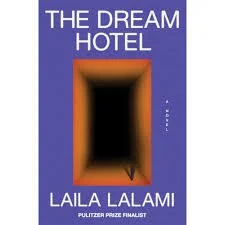
Sara Hussein is detained for questioning at LAX, upon her return from England where she attended a professional conference. Her interviews by two Risk Assessment Administration (RAA) agents does not go in her favor, and she is sent to Madison, a detention center for women who are suspected of being at high potential for committing a crime. While not a prison, since “residents” have not committed a crime, their circumstances are not discernably different. Sara and her fellow inmates suffer deprivations, indignities, and abuses that gradually diminish mental health, increase stress, and make it harder to follow indiscriminate rules.
This dystopian setting is in the near future, when neuro implants sold to improve sleeping, in fact record dreams that are data points toward an individual’s risk assessment, or probability of committing a crime. Taken together with public video surveillance, data collection from smart phones and social media, and meticulous records of family history, and individual history from childhood, an algorithm determines your potential for criminal behavior. Corporations serve as contractors to run data collection, detention sites, food services, and every opportunity is sought by these corporations to make money from inmates. DreamSaver, the neuro implant meant to improve and shorten sleep, is being tested for a procedure where elements are inserted into a dream, intended to increase sales of items through suggestion.
To combat crime rates, citizens have agreed to surrender their civil liberty with detention for potential for crime, based on an algorithm that seems highly suspect and manipulatable. Since corporations run detention centers, every effort is made to reduce costs and make money from residents. Sara is a professional archivist working at the Getty Center; her husband Elias is a speech therapist, and they have twin toddlers, a boy and a girl. Sara misses nearly a year of their lives during her detention, and is concerned that she will not be able to get out at all, suffering extensions of her confinement for arbitrary infractions. We see many familiar breakdowns in corporate services, from failed deliveries, delays, and poor product quality, that everyone is forced to endure, out of fear that complaint could lead to a rise in one’s risk number.
Sara is naturally a strong person, quick to stand up for herself, unwilling to tolerate injustice or poor treatment, and she is smarter than many around her. This is a difficult time to have these qualities; people are mentally beaten down, going along to get along, generally on a spectrum of depression, based on their learned helplessness within the society where they have allowed their freedoms to be stripped away “for their own good.” This is an intelligent novel, demonstrating the consequences for individual’s lives where we surrender freedom for safety, and allow commercial interests to take control. The author has a keen sense of the psychological and social consequences of this deal, and that the strong-willed will be the ones to suffer greatly.
A finalist for the Pulitzer Prize, this is not an overly intellectualized novel, but rather a well-crafted story with an important warning for us. Technological innovation isn’t necessarily the solution to all our problems, since they are rarely without a profit motive that could undermine our freedoms, commodifying us. This is a society where individuals are not seen as persons, but as opportunities for making money, and government officials are not elected to improve our lives, but to serve corporate interests. This book was downright scary, and I highly recommend it. It is in the running for my best novel for 2025.