
Celestial Lights, by Cecile Pin
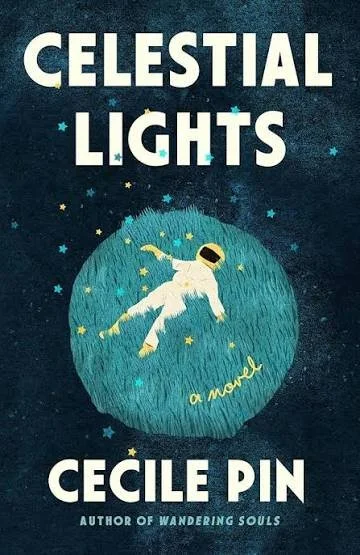
Oliver Ines was born on the day space shuttle Challenger exploded and fell from the sky. Pin reveals his character in a delicate, gradual way, both to himself and the reader. He has a childhood fascination with the universe, as told through his choice of luminous wallpaper filled with stars and planets for his bedroom, selected as a young child with his parents. A highly curious child, who seems somewhat apart from his peers, he meets Philly when he is nine years old. She has a fascination for insects, sharing her obsession with cicadas, who surface from nests within the earth each seven years, to sing, mate, and die. Together that summer, they search her aunt’s backyard, never finding the illusive insect. Philly’s parents return to bring her home, and many years pass before Ollie and Philly meet again in university.
Pin’s story is told with two timelines—Ollie’s chronological life and its events, and the Phoenix space mission, as told via Ollie’s personal log as mission commander. We see Ollie’s self-reflection as a young person, as a university student, and as a professional, making choices that lead him along the path of space exploration, and ultimately, history-making significance. Pin is very skilled at pacing and character development, rising action to a climax, the reader trotting along eagerly to see who survives the groundbreaking endeavor.
Pin has written so much more than an ordinary science fiction novel. She is questioning the motivations of space exploration for the human race—why spend extraordinary sums of money to establish off-Earth colonies and push further into space, when that money could be used to solve our Earth-bound problems? What honestly motivates those who choose to be the explorers? As we go further into space, the length of missions grows significantly—why would anyone with spouse and child choose to leave them for ten years, essentially missing their child’s childhood? Are astronauts the daring heroes we make of them, their courage in the face of dangers on behalf of humanity as a whole? Or is there something missing in their character, that drives them to abandon life on Earth, the messy ordinariness of responsibilities of jobs and family, to seek an extraordinary life, recognition, singularity, acclaim, novel experiences? Pin turns over this rock to look at the unseemly side of space exploration, mostly for those who go to space, but also questioning the motives of those who construct and financially power these missions. What motivates Musk and Bezos? Why, honestly, are they motivated to reach beyond our home on Earth, to establish home bases elsewhere?
Pin comes to this exploration in a beguiling manner—Ollie is a decent, honorable man, but not deeply self-reflective. He feels the strong pull of space exploration, but never really asks himself why he makes his consequential choices. He doesn’t have much more knowledge of his motivation at the end than at the beginning, as he begins to attempt to put his life back together. His lack of empathy for his loved ones is astonishing, made the more jarring by Pin, since Ollie is not an unkind, selfish person, but rather, superficially considerate and well-mannered. The fact of his decency makes his choices that much more impactful for the reader.
This novel is well-crafted, well told, and insightful. It asks important questions, both on the macro level and deeply personal level. You will find yourself pondering its questions for some time. Highly recommend. Book clubs will like this one.