
Dinners With Ruth: A Memoir on the Power of Friendships, by Nina Totenberg
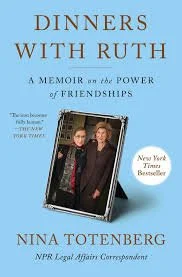
It was inevitable that Nina Totenberg, NPR’s Legal Correspondent and noteworthy reporter on all things of consequence judicial in Washington, D.C., and Ruth Bader Ginsberg, DC Circuit judge, then Supreme Court Justice, would know one another well. What those of us not involved in Washington’s media or judicial networks might not know is the pair’s longstanding friendship, which long predated Ginsberg’s 1993 Supreme Court appointment by Bill Clinton. Their first contact was of a professional nature, when Totenberg read Professor Ginsburg’s brief, solicited by the ACLU, for a Supreme Court case in 1971, Reed vs. Reed. Totenberg asked the Rutgers law professor to explain her position, and that phone call was the start of an almost 50-year friendship.
Totenberg’s book is a larger memoir of friendships in her life, from her sisters, to her work relationships at NPR, especially with Susan Stamberg, Cokie Roberts, and Linda Wertheimer, to judges including RBG, Justice Antonin Scalia, Justice Stephen Breyer, and Justice Anthony Kennedy. She has interviewed nearly all Supreme Court justices, and many others on the political scene in Washington. A self-avowed work obsessive, she discusses her marriages, and the decision not to have a child, a difficult choice every working woman must face. Totenberg is candid about careful, but clear lines that must be drawn between private life and professional life as a journalist, and how she and Ginsburg successfully and sensitively managed those considerations with each other.
Of special note for me was her description of the special and close friendship between Scalia and Ginsburg, and what viewpoint was needed to find close common ground for people on opposite ends of the judicial spectrum. Both justices were perhaps the most candid, outspoken proponents of their times for conservatism, originalism and textualism in interpreting the US Constitution (Scalia); as opposed to liberalism and the “living document” view on the Constitution, and judicial activism reflecting current societal views (Ginsburg). It seemed their mutual respect for each other’s intellectual ability, work ethic, decency, good humor, and love of opera transcended professional differences. Two people could not have differed more in viewpoint, yet two people completely enjoyed each other’s company, even traveling together and socializing often. Totenberg was fortunate to have witnessed their relationship up close, and shared it as well.
Totenberg is honest about her weak spots of not living up to reasonable expectations of friendship at times. She can be too work-driven, avoided certain issues when coming closer might be too painful or difficult; for example, when colleague and friend Cokie Roberts went through chemo for breast cancer. Totenberg couldn’t make herself be part of that support team, letting Linda Wertheimer take the lead and accompany Cokie for each treatment. It is a truism that we cannot be all to all our friends, but must choose those things we can do, and have others pick up other support needs, fair enough.
If you enjoy “inside baseball” stories about the Washington-Media matrix, this will be a book you will enjoy. It is also a good reflection on women trying to break into male-dominated fields and workspaces in the seventies onward, a viewpoint quite different from today. If you are looking for more of an insider’s view of the workings of the Supreme Court, I recommend Listening to the Law, by Justice Amy Coney Barrett (https://www.margueritereads.com/home/listening-to-the-law-reflections-on-the-court-and-constitution-by-amy-coney-barrett?rq=listening%20to%20the%20law).