
Jackson Brodie Novels, by Kate Atkinson
Atkinson’s Jackson Brodie series of crime novels doesn’t completely feel like traditional genre fiction. Although clearly influenced by the classic whodunits of Agatha Christie and Dorothy Sayers, the solving of cases makes up the action, while internal observations of the detectives seem of more consequence. It is the characters of Jackson Brodie, then Reggie Chase and Louise Monroe, that keep the reader coming back eagerly to the series. Each suffered loss at vulnerable, formative times of life. Each had to develop coping skills early, relying on hard work and resourcefulness to get through. Those early losses lead each to compulsively protect the vulnerable, confront and defeat bullies and bad people taking advantage of and harming them. They are each very likeable—we root for them, want them to form close relationships, be happy and safe in life. We meet Jackson in his forties, and follow his life until he turns sixty in the sixth novel. I fear we may have only one more Jackson book, since the physical nature of his job, sustaining all manner of bodily harm, cannot continue much further. The cynical, sarcastic humor is very appealing. The plotting is delightfully twisted; the artful, rapid character development, carefully observed with spare, precise detail, is masterful. You will love this series—use your public library to acquire each novel, and enjoy every minute with an excellent writer.
Case Histories (2004):
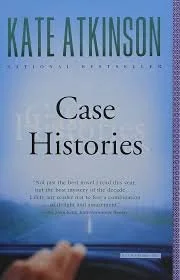
Wherein we meet Jackson Brody, recently retired from the police as an inspector, after a stint in the Royal Army, presently self-employed as a private detective. We are presented three cold cases Jackson is trying to solve: one, when two sisters, Julia and Amelia Land, are cleaning out their recently deceased father’s house, the family home, a comfort stuffed animal, Blue Mouse, is discovered, locked in their father’s desk drawer. This was the constant companion of their sister, Olivia, who disappeared at age three, never found after an extensive police search; two, Theo has tried to solve the mystery of who murdered his beloved eighteen-year-old daughter Laura on her first day at a summer job, working in her father’s solicitor office, when a nondescript man wearing a yellow golfing sweater wielded a knife, slashing one of Theo’s business partners, and killing Laura; after ten years of searching, and suffering deepening depression, he turns to Jackson for closure and resolution; and three, Shirley lost track of her sister after she went to prison for the axe murder of her husband—Shirley promised to care for Michelle’s baby, Tanya, but the husband’s parents insisted on raising the child. After the child ran away from home as a teen, Shirley, 25 years after the murder, asks Jackson for help to find the child.
A fourth mystery is introduced when we learn about Jackson’s childhood—after his mother dies when Jackson is eleven, his sister is working as a secretary and caring for the family. Their other brother works in the mines, which is where his retired father worked, who now drinks his time away. One rainy night, when the older brother doesn’t go to pick up his sister at the bus stop, she goes missing, only to be found dead in the canal, raped and murdered. His brother cannot live with himself, and hangs himself in their home. This motivates Jackson to leave home for the Army as soon as he can. The murderer is never found, at this point in the series. Jackson’s father dies about a year before this story begins, and his sister’s murder is never far from his thoughts.
Jackson was married to his first wife Josie when he was a policeman, and they have a daughter, now eight-year-old Marlee. Josie divorced Jackson, taking up with David, a college lecturer, and the divorce is still very painful for Jackson. He cannot handle knowing this man is living with his young daughter, leaving Jackson unable to protect his daughter and teach her the skills she will need to stay safe.
Binky Rain, wealthy, aged dowager asks Jackson to find her ever-missing black cats; Jackson is more concerned with checking in on the elderly woman, who no one else seems to care about. Mrs. Rain happens to be the next-door neighbor of the Land family, and was picked on by the girls, called a witch, until Olivia went missing.
Atkinson twist these mysteries like threads of yarn, beginning each chapter with a different narrator. We are usually in Amelia’s or Sylvia’s head for the first mystery, in Theo’s perspective for the second (although later, from Laura’s viewpoint), and Michelle narrates the third mystery. In present time, we see most everything through Jackson’s point of view, as he juggles the investigation of each. Nothing feels systematic about Jackson’s process—he runs from pillar to post, assailed by one or another, tripping into information, attacked by malefactors. The novel feels more like a study of Jackson Brodie— an examination of what losing his sister, mother, and brother cost him, how it damaged him, a study of his ideas about manhood, his role as protector, the place of tender feelings in his relationships, and how his needs drive his choices, for good or ill.
One Good Turn (2006):
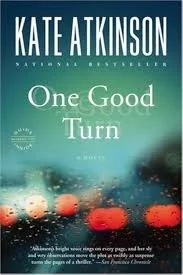
Two years on, Jackson Brodie and former client, actress Julia Land, have had an ongoing affair, while Jackson has sold his detective business to his former admin assistant and purchased a country home with acreage and in-ground pool an hour south of Paris, funded by his inheritance from a wealthy heiress client, Binky Rain. At forty-eight, Jackson is too young to put himself out to pasture, feeling rudderless, purposeless. He accompanies Julia for her acting gig, a play at the Edinburgh Festival. It is obviously a more obscure, off-beat production, and Julia is behaving more estranged toward Jackson, avoiding dates and meetups, making one excuse after another. Meanwhile, Jackson can’t help but get dragged into a series of convoluted mysteries.
While standing in a queue for one of the festival events, Jackson witnesses a road rage attack, when a Honda gently rear-ends a Peugeot, an ugly hulk wielding a baseball bat comes out to whack the conciliatory Peugeot driver. A meek bystander hurls his laptop bag at the hulk, pulling him away from finishing the man off. The queue of witnesses and participants is each involved in their own drama, most of which are illegal-adjacent, and strangely intertwined, unbeknownst to each of them. Chasing clues as unrelated attacks pop up, Detective Inspector Louise Monroe, balancing her serial shoplifting, troubled teen Archie and aging cat, Jellybean, crosses paths with Jackson. They have sarcastic exchanges, with plenty of underlying sexual tension. Both detectives come from tough family backgrounds, are talented, but struggle with lack of confidence and fear of intimacy. A writer of lame cozy mysteries, a hitman, a wealthy builder of schlocky homes and money laundering, his wife, looking for an exit before it falls apart, the Russian mob, and a knife-wielding Russian beauty looking for the big take—Jackson and Louise separately bounce between these characters, with Jackson sending Louise clues as he acquires them. As the characters clash in a final uproarious confrontation, Julia’s play is premiered, their relationship comes to an abrupt denouement, and Jackson has no further reason to hang about Edinburgh. Although he wants to pursue Louise, their insecurities prevent either from proclaiming their feelings. We are left hanging, realizing (hoping?) that we will see a future for Jackson and Louise eventually, if they each can manage to find the confidence, and lose the excuses. Jackson’s brief relationship with Louise further highlights and develops Jackson’s character, forcing him to confront himself, and perhaps, start a relationship that will be mutually beneficial and rewarding, something he repeatedly succeeds in avoiding.
When Will There Be Good News? (2008):
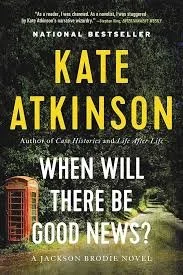
We first see Jackson Brodie surreptitiously taking a hair from Nathan, Julia’s boy, at his preschool outside play time. Written in a clever way, we don’t know who the man is, or what his intentions are, but when the children come out to play, the man identifies Nathan. Reader thinks he is grooming or planning to snatch the child, pats child’s head, children run away, man is confronted by a minder. Then we learn it is Brodie.
Continuing from One Good Turn, Jackson’s relationship with Julia ended, she married another man, but Jackson suspects that Nathan is his child with Julia. He boards a train to head back to London, but mistakenly gets on a northbound train, heading to Edinburgh.
Atkinson known for her complex plotting, bouncing between character’s first-person narrative. These jumps get shorter and faster as we head toward the climax. The reader must pay close attention, for it is often unclear whose thinking we are privy to, and we must look for contextual clues quickly to establish who’s head we are in.
Threads include: Louise Monroe, Detective Chief Inspector, had a brief nonromantic encounter with Jackson in the last book. She recently married Patrick, an orthopedic surgeon. He sounds perfect in every way, but she is bound to destroy the relationship. Workaholic, she has two cases in mind where a murderer is being released from jail after serving their time, but each has unfinished business, and she is concerned that these men will stalk family to “finish the job.” Andrew Decker served thirty years for killing a mother and two of her three children, the middle daughter running away and hiding in an adjacent wheat field. Dr. Johanna Hunter, the survivor, now wife and mother to baby Gabriel, is aware of the release; in fact, she visited Decker in jail a month ago. She and the baby go missing, and the husband is clearly lying, saying she is caring for an aging aunt. Reggie Chase, 16-year-old baby minder for Dr. Hunter, whose mother died under strange circumstances a year ago, has an older drug dealer brother who is becoming increasingly erratic and dangerous. Characters are all brought together when the train Jackson is traveling on topples off the tracks behind the house where Reggie helps an older, dying woman, another of her jobs to get by. It is this train wreck that brings Reggie, Jackson, and Louise together, twisting their plotlines in an elaborate, unpredictable pattern. The propulsive action moves forward as Reggie is trying to help Jackson and find the missing Dr. Hunter and child, alternately helping Jackson and enlisting his help, and Louise is also trying to prevent two murderers from completing their self-assigned tasks.
This installment further develops our understanding of Jackson Brodie, his great love for women, trying to save them, his yearning need for a wife, but inability to maintain a relationship. While not figuring greatly in this novel, Jackson’s daughter Marlee is about Reggie’s age, so his relationship with Reggie mirrors that of his daughter’s. He compares the two, in an effort to understand how to get closer to his daughter. He contemplates whether he wants to know for certain if Nathan is his son, and what that would mean for his relationship with him. Jackson impulsively marries a woman he barely knows, a conservator at the Victoria and Albert Museum, who he meets at a cocktail party. Turns out it was all a setup-- she learned of his windfall inheritance from Binky Rain. The new wife cleaned him out when he was in hospital due to the trainwreck, and disappeared. When he checked, everything he thought he knew about her proved to be false.
We learn more about Louise, so similar to Jackson in her need to protect innocence, stop those who mean others harm. She was raised by an alcoholic mother, no father in her life, just as Jackson tragically lost his mother, sister, and brother in one year, as a young boy. They both are driven to help others during life’s worst moments, as if trying to relive and master the tragedies that so crippled themselves. If the logic holds, Reggie is likely to become a detective, too.
Started Early, Took My Dog (2010):
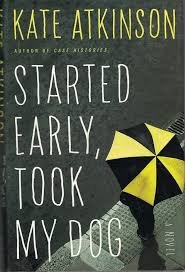
This novel features a real-life serial killer, Peter Sutcliffe, known as the Yorkshire Ripper, in homage to Jack the Ripper fame. Sutcliffe killed prostitutes, then random women from 1975 to 1980. Several detectives working together, a sort of boys’ club, misbehave with local prostitutes, when one is murdered and her 4-year-old child is with her, locked in the apartment until her body is discovered three weeks later, due to the odor. Tracy Waterhouse, uniformed police woman at the time, scoops up the boy, and delivers him to the social worker. This encounter never leaves her memory, however, her regret that she didn’t rescue the boy from the system, adopt him, give him a home.
Looking back at the events of 1975, Tracy is a retired detective inspector, now working security at a shopping mall in Leeds when she witnesses a local prostitute dragging a little girl around in an abusive manner. She impulsively takes the child, throws money at the street walker, bringing the child home, and wondering how she can make the girl safe, give her a chance at a good life, and not get arrested for abduction or trafficking.
Jackson Brodie has a case from New Zealand—Hope McMaster, motivated by her pregnancy and impending delivery to uncover her secret past, employs Jackson to look into the circumstances of her adoption in UK, how her loving adoptive parents came to find her. When the meager details Hope had shared prove false, Jackson is led on a wild goose chase, trying to track down the detectives of nearly forty years before, believing that the murder of 1975 might be the key. Along the way, in a chance encounter with a huge bully, Jackson liberates a small dog, a loyal, intelligent, talented border terrier, who accompanies him on his investigation, returning the favor by saving Jackson from a terrible death.
Aside from one ill-advised roll in the hay, Jackson sticks to the agenda, for the most part. We learn at the end that Julia’s son Nathan is indeed his natural son, and Julia is willing to share time with the boy, but not to the point of reconciliation with Jackson. Meanwhile, Detective Inspector Louise Monroe is never far from Jackson’s thoughts, the same as his beloved, deceased sister, Niamh. Jackson is doomed to search for the lost, recover the past, rescue those women in need of help. He is also doomed to receive too many punches to the head, and kicks to the ribs. I worry about whether traumatic brain injury is in his future.
Well-developed characters continue to be Atkinson’s trademark, with the relationship between Tracy Waterhouse and her three-year-old acquired girl, charming with her thumbs up responses, waving her fairy wand, and acquiring more treasures for her backpack, beguiling the reader, with each providing the opportunity to love and be loved that they both need.
Big Sky (2019):

Jackson Brodie is renting a cabin in a national park in Yorkshire, in a wooded area adjacent to a cliff along the North Sea, northeastern England. He is again working as a private detective, at this time mainly collecting evidence for wives on their cheating husbands, photographing trysts, or in one case, posing online as an underage girl to catch the husband posing as a teenage boy, plotting to hook up with the juvenile. He is spending more time with his son with Julia, Nathan, now 14 years old, and Julia’s aging dog, Dido, while she continues working as an actress on the TV series Collier. He is also anticipating his daughter, Marlee’s pending wedding, to the son of an old money family. While Marlee has received the best education, and is poised to start her career as a solicitor (legal professional), she is pregnant, and increasingly questioning her approaching nuptials, as is Jackson.
While out working his jobs, Jackson stumbles upon a web of crimes: first, a murder; next, a beautiful woman being followed repeatedly; then, attempted kidnapping of her two children. Finally, he becomes wrapped up in an illicit business of golfing friends who import young women looking for opportunity in England, only to drug them, abuse them, and sell them into the sex slave business. This group of three men were trained as young men by an older group of men known as the Magic Circle, two of whom were caught and serving time; the rest, well positioned and protected as retired legislator, police chief, and judge, are being tracked down by MI5 and Detective Constable Reggie Chase and Ronnie Dibicki, as the women work through the considerable paperwork from the former prosecutions, hoping to find the other members of the ring. Their searches bring them closer to the players in the sex trafficking business.
Of course, we know at the critical moment, Jackson and Reggie will re-unite; as predicted, Reggie is in law enforcement. The theme of those who were vulnerable to harm and loss in their youth becoming those bound to save other vulnerable people, and catch those who harm them, a continued theme.
Of interest in this book is the role played by the wives of the unlawful businessmen. They are no strangers to the sex trade, as one managed to pull herself out of that servitude and remake herself, only to find herself married to yet another culprit. The women don’t know the illegal nature of their spouses’ business, but have suspicions, and are planning safe exits when everything goes south, as it is likely to go, eventually. None believe their husbands capable of pulling off an illegal operation for long, regardless of what it is; they share low opinions of their intelligence.
We see Jackson yet again helping women who have fallen prey to bad men, something he simply cannot resist engaging in. This is the second time he and Reggie have conspired on the fly to lie to law enforcement, protecting people who committed seriously unlawful acts, who killed either in self-defense, or who had suffered severely, took justice into their own hands, and did not deserve punishment. “Bad people were punished, people with good intentions weren’t crucified.” Jackson and Reggie both feel squeamish about it, but not enough to take a different course of action, in unspoken acknowledgement of the imperfections of the system of justice.
Of course, we are hoping that Jackson will have the courage to contact Louise, but be prepared for more disappointment. And Jackson has one more girl to save, his own daughter, from making the mistake he made long ago. Of course, Jackson always strives to save the girl.
Death at the Sign of the Rook (2024):

Jackson Brodie continues working freelance cases in Yorkshire, northern England. We have several plotlines that slowly, then quickly become tangled, leading to quite a madcap ending. When investigating a stolen painting of possible great value, Jackson again crosses paths with Reggie Chase; Reggie is working a similar case of a painting stolen from a Downton Abbey-style great house called Burton Makepeace. It becomes clear to them both that the suspects in each case are likely the same woman, going under different names, inserting herself into situations where she develops trust and intimacy; in Jackson’s case, a carer for an aged, dying woman; and in Reggie’s, the maid and companion of Lady Milton, aging widow of Lord Milton, hereditary heir of Burton Makepeace. In Jackson’s case, when the old woman dies, the painting and the carer disappear. At Burton Makepeace, Lady Milton’s son, Piers, has been selling off art to make basic repairs to the sprawling mansion. A valuable painting by Turner goes missing, as does Lady Milton’s companion.
Following Jackson and Reggie’s investigations, we meet an amusing cast of characters: Hazel and Ian, adopted children, now adults, of Dorothy Padgett (the now deceased), Hazel’s daughter and family, Dorothy’s neighbor Bob, the extended Milton family, as well as neighbors living in homes formerly part of the great house, but sold off to pay the upkeep bills. Piers has converted the east wing of the house to a hotel which promises a Downton Abbey-style experience, and is holding a murder mystery weekend event to bring more customers. The actors, a group of third-rate performers called the Red Herrings Theatre Company, a motley crew whose leader, Titus North, created a script that steals a mystery from one of Nancy Styles novels (Nancy Styles, a fictional author, sort of a pulp fiction, Agatha Christie wannabe.) Add to that weekend a big snow storm, and an escaped convicted violent killer, and this is sure to be a crazy denouement.
Most of the story is told from Jackson’s and Reggie’s viewpoints, which bring much of the humor. Jackson, suffering insecurities having reached the age of sixty, thinks all the judgmental things about people that we often do, and those quirky inner thoughts are hilarious. While having great ambitions regarding her career, Reggie also harbors a secret desire to be romantically swept off her feet by a handsome, able, manly man. Reggie doesn’t want to work with Jackson, whom she finds somewhat annoying, but despite herself cannot help but like and respect him. Other characters are cleverly given depth and believability, such as the vicar Simon Cate, who loses his faith and his voice; and Ben Jennings, returning Afghanistan Army major who lost his leg, and his purpose. Atkinson uses great economy in plotting, for each character will play an important part, and gets expertly woven into the action. Detective Inspector Louise Monroe gets a walk-on part in this story, leading the police responding to the call about the escaped killer at Burton Makepeace. Her reunion with Jackson does not advance their romantic future, unfortunately.