
Horse, by Geraldine Brooks
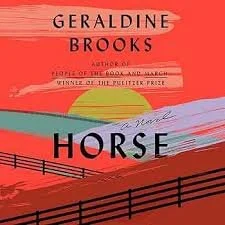
Horse brings together a varied group of people to tell the story of Lexington, an Antibellum-era thoroughbred, fastest horse in America for twenty years, sire to 575 foals, the greatest number of champions of any horse in history. The novel moves back and forth from Lexington’s time to the modern age. Jarret, known throughout the novel as Warfield’s Jarret, Ten Broeck’s Jarret, and Alexander’s Jarret, reflecting the men who owned him as an enslaved person, until he is freed, and known as Jarret Lewis, is the son of Harry Lewis, a black man who bought his own freedom, and was known as a skilled trainer and breeding advisor. Jarret assists his father, learning the trade, when the foal Lexington, then known as Darley, is born. Jarret will care for this legendary foal throughout his life, recognizing its potential for greatness, and bringing his sensitivity and love to the responsibility. Harry cannot raise the money to purchase his son’s freedom before Warfield sells Jarret and Lexington to Richard Ten Broeck, a wealthy man seeking to earn riches with Lexington at his new Metairie Racetrack in New Orleans.
We also meet Thomas Scott, a Northern painter, trying to make a name for himself in the world of equestrian art. He ingratiates himself to wealthy plantation owners, in order to paint prominent works for display, and bragging rights. Through Jarret and Scott, we learn about the racing industry, that sits on the back of slave labor, with owners equating their ownership of horses and humans. Jarret puts himself in harm’s way many times, in his effort to assure that Lexington receives the best treatment and training, not putting the horse’s long-term health at risk for short-term gain.
Around 2019, we meet two academics who are learning about Lexington in their areas of expertise: Jess, an osteologist, a scientist specializing in the study of bones, and Theo, an art history doctrinal candidate studying equestrian art, and the depictions of black jockeys, grooms, and trainers. When Theo finds a painting from a neighbor’s sidewalk discard pile, he seeks to identify the horse and groom; while Jess unearths an amazing articulated horse, a reconstruction of the horse’s bones in lifelike pose, exploring the identity of the horse. Their paths cross, and the scholars help one another in the interwoven mysteries.
Brooks weaves fact and fiction masterfully, juggles the timelines skillfully, but the story suffers from long periods of a slow pace. The reader is eager for the story to take off, gain momentum, provide some excitement. The best parts are the interactions of Jarret and Lexington, watching their relationship develop, as Jarret trains and prepares Lexington for the role he was born to play, helping the horse to fulfill his promise. The story finally breaks into a canter when the Civil War arrives, and both storylines meet their climax. There is much to be learned in this novel, but the reader must persist through Brooks’ somewhat stilted, wooden prose, her slow pacing.
I must recommend Horse for the chance to meet Lexington, to experience Jarret’s love of the horse, and the reader’s opportunity to learn about this shameful part of racing history. Just come prepared to spur yourself to go the distance in this sluggish, poky story telling.