
Ply, by Hernan Diaz
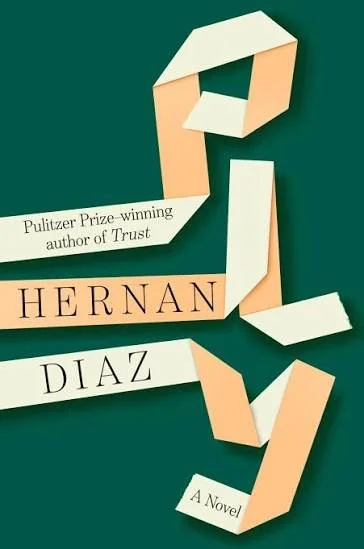
Hernan Diaz, in my experience, authors dense novels filled with well-researched information and deep ideas. He enters a world completely, takes you down the rabbit hole, and you are not released until that subject has been thoroughly considered. I can recommend to you his 2022 novel Trust, and this year’s novel Ply. He is not for the faint of heart—you will have to endure lectures from passionate, opinionated characters, sometimes lasting pages (but not too long—the record goes to John Galt of Rand’s Atlas Shrugged). Here you will learn about particle physics, sub-atomic particles separated and studied in the Large Hadron supercollider in Switzerland, for example. All physics Diaz discusses is real, and is presently researched—this is not science fiction. He tries to give the reader enough information to follow along, and is interested in the bigger questions such research opens up, questions of who we are, what is consciousness, and what is the actual structure and meaning of the universe, time, and us.
The setting is New York City, centuries in the future. There is no government of any kind, and society as we know it has completely collapsed. Trade is by barter, living is largely subsistence, and the level of technology is low. There is an electric power grid, provided north of the city by an entity called Tensor, but few folks can afford it. Working people live downtown, with wealthier people living in the decaying high rises of uptown. No hospitals, no phones, no formal education. Life expectancy is short, since people die of disease and injury we formerly could cure or fix, but that knowledge and those resources have all but disappeared. Fertility is very low, and people behave oddly toward the few children they meet. Many are kind to children, since they are few; others treat them as a tradeable commodity. The only enforcers are a loose band called CTS, made up of contractors and volunteers, who work mainly at the behest of Tensor, disappearing suspected dissidents.
The first part of the novel is told in first-person by our unnamed protagonist, the early life of a female born in this time and place. It follows her difficult past, until part two, when she works independently as a pincher, someone who builds batteries, hooks them up to the grid, and siphons off electricity. She then sells that power, mostly to music groups for their nighttime clandestine performances around the city. In part two, she is referred to as the pincher, and the novel proceeds in the third person, although mainly from her perspective. Carrying out her illegal activities in a very careful, paranoid fashion, she becomes aware that she is being watched, until that observer reaches out to her, wanting a meeting.
This leads to meeting Pola, an older woman, a trained physicist of great wealth, holed up in the basement of what I believe is the Cloisters, a “former” museum of medieval art and architecture on the northwest tip of upper Manhattan. She is of questionable mental health, and appears to keep manic depression, or some sort of illness under partial control by self-medicating. Pola has built a Wakefield device, a particle accelerator, with the purpose of breaking down matter to its smallest constituent parts, beyond what has been previously done. She wants to discover what are the absolutely smallest bits of stuff, to verify her belief that spacetime itself is matter, and by breaking it down and rearranging it, we could alter everything—who we are, time itself. She believes all answers lie in the minutest of matter, its arrangement, its principles. Pola has observed the pincher, and believes she can assist her in this experiment. She also needs her to supply the power, since Pola will need all the energy Tensor supplies to the city. She needs to develop a larger battery, one that is still moveable by the two women, to pinch all the power quickly, and give them time to escape.
So this novel carries us through the pincher’s life in this post-America, post-civilization city, to an experiment to test the understanding of the fabric of life itself. I am not a physicist, and neither is Diaz. He has consulted the leading minds of our times, studied what is known extensively, as a layman, in order to bring enough understanding to the reader to make this work. It is a challenge to wrap your mind around, but Diaz needs to accomplish this to ask the questions he has about individuals, what we are, why we are, and where we are going. I’m not sure he resolves anything for all his questioning, but that’s okay. He presents a punk, do-it-yourself, tinkering world, anti-establishment because there is no establishment. It is all very interesting, and well-written. Don’t expect answers, just enough information to ask and ponder many questions. There aren’t many novels out there these days that explore deeper questions, and do so in an interesting way, so I must recommend this one.