
The Uncool: A Memoir, by Cameron Crowe
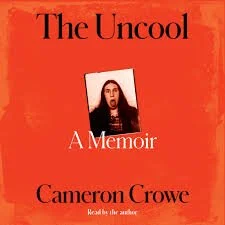
Cameron Crowe lived the dream of every person born in the late Fifties and early Sixties— he spent his teens traveling with some of the biggest rock performers of that time, at the time of their greatest music’s creation, interviewing them and trying to capture the magic of the moment in interviews for the most influential music magazine of the time, Rolling Stone. There was a time the groundbreaking milestone, when a new band or performer became the biggest act of the moment, knew they had made it, when as in Dr. Hook’s 1972 song,
Well, we're big rock singers, we got golden fingers
And we're loved everywhere we go (that sounds like us)
We sing about beauty and we sing about truth
At ten thousand dollars a show (right)
We take all kinda pills that give us all kinda thrills
But the thrill we've never known
Is the thrill that'll getcha
When you get your picture on the cover of the rolling stone
wanna see my picture on the cover
(Stone) wanna buy five copies for my mother (yeah!)
(Stone) wanna see my smiling face
On the cover of the Rolling Stone
Crowe wrote 16 cover interviews for the Stone, the first when he was fifteen, and the list is the soundtrack of my teen years, including:
The Allman Brothers Band
Led Zeppelin
The Eagles
Neil Young
Fleetwood Mac
Joni Mitchell
David Bowie
Bob Dylan
Tom Petty
Bruce Springsteen
Yes
Jackson Browne
Rod Stewart
Eric Clapton
Peter Frampton
Linda Ronstadt
At the time, many of these performers refused to sit down with any journalist, especially from the Stone. Why did they agree to open up to Crowe? I can only speculate that when they looked in his eyes, with his openness and enthusiasm for their music, they knew they were speaking to their fans, young people who really got it. Many were performative— they knew they had a persona, and they played up to that. But Crowe captured some when they were most vulnerable, such as the Gregg Allman interview, when the band released and performed their first music after the death of brother Duane Allman, and somehow they managed to pull it together and fulfill the dream. Much of that experience was captured in the movie Almost Famous, for which Crowe received the Oscar for Best Screenplay.
The memoir captures these unique experiences, but in the context of Crowe’s family trauma and tragedy, the loss of his beloved oldest sister, Cathy, to suicide; the conflict between his sister Cindy and his mother; the pressure he felt from his mother to become a lawyer like his grandfather. His mother, Alice, was one of a kind— filled with wisdom she dispensed to her community college students, she was conservative in her parenting, but liberal politically, passionately backing social causes. Letting her son go off to travel with druggie, drinking rock bands was very difficult for her, but a credit to the trust she felt in him. He was the peacemaker of the family, yet he also had to pursue his most heartfelt desire.
The story covers some of Crowe’s transition to film making, with the writing of the novel Fast Times at Ridgemont High, to the making of that movie, a bit about making the movie Almost Famous, then fast forwarding to the making of the stage play Almost Famous: The Musical. The memoir is an homage to his family— the core influence of his mother, the love for his sisters and the gift they gave him of the love of rock; and the steady, easy-going nature of his father, acknowledging that he gave up a successful military career to create this family.
I couldn’t put this book down. It certainly is already the most meaningful book I’ve read this year. It is written for every kid who listened at night to their transistor radio (trying to catch WABC in New York, or the then-venerable WNEW “where rock lives”), who tried to save up enough to buy a new release of their favorite band of the moment, who remembers concert experiences as the greatest moments of their young lives. Before the internet, the web, or social media, when authentic, raw music blew into your life, got made into tapes to share with your friends, capturing the magic of the moment. Read this book, if you can relate. “We few, we happy few, we band of brothers.”