
The Vanishing Family: Love, Fate, and the Quest to End Dementia, by Robert Kolker
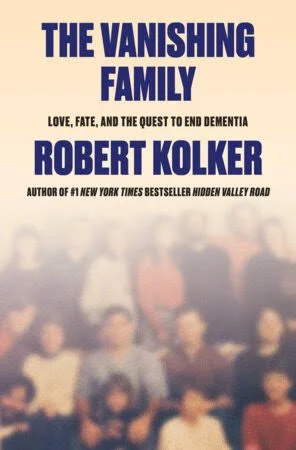
Robert Kolker has become the master of researching and writing nonfiction books about families suffering extreme examples of maladies challenging society. His book about the Galvin family, where six of the twelve children suffered schizophrenia, was heart-breaking and informative—Hidden Valley Road is a must-read (https://www.margueritereads.com/home/hidden-valley-road-inside-the-mind-of-an-american-family-by-robert-kolker?rq=kolker). In The Vanishing Family, he discusses a family of nine siblings, five of whom develop frontotemporal dementia (FTD). This is considered a rare disease, with approximately sixty thousand American sufferers, as compared to the fifty-five million diagnosed with Alzheimer’s disease worldwide. FTD is passed on through the genes; scientists have identified the mutation, one singular mutation, that produces it. The mutation leads to an overproduction of tau protein, a protein needed in normal amounts for healthy neurons, but in overdrive will cause frontal lobe dementia. Unlike later developing Alzheimer’s, FTD typically begins manifesting in your early forties, although it can begin as late as sixty. If your parent has FTD, you, as their child, have a fifty-fifty chance of inheriting it.
Kolker presents this family’s experience so sensitively. Which is worse—being a victim of FTD, worrying about losing your identity, becoming a burden to your family, losing memory of everyone you love, knowing your children may well walk the same tragic path; or not inheriting it, bouncing between grief and guilt, bearing the burden of supporting family who cannot support themselves. The disease begins with emotional effects, as opposed to the cognitive losses of Alzheimer’s—those affected lose empathy, lose self-control, lose any concerns except to pursue appetites and desires of the moment. They may still function initially in their professions, but do not care about others, even loved ones. They may eat excessively, start drinking alcohol to excess, become sex addicts, gambling, shopping, all manner of impulsivity. They can easily become unlawful, speeding and driving recklessly. Neglecting their children, leaving their spouses for other partners, dropping all obligations, breaking the law—wreaking havoc that supportive spouses or siblings are stuck cleaning up. All this loss begins at the prime of life—formerly bright, contributive people become unrecognizable.
Before these affected siblings knew what was happening, and how it was passed down, they had children. Kolker describes how not only the five were impacted, but five of their ten children were also afflicted. As we progress in time to the 2020s, it becomes much easier to diagnose, before symptoms manifest. However, at what time of life would you want knowledge that this could happen to you and your children? Each person chose differently—some wanted to know early, to financially and emotionally plan ahead, while others chose either to live without the knowledge until later, or not at all. Some siblings were natural caregivers, others did what they could to support and help, still others chose to go live their own lives apart. Kolker is masterful at teasing out the nuance of each sibling and child, and there is plenty of suffering to go around. He doesn’t ever lose sight of the love they have for one another, which makes the book endurable.
Kolker weaves in the scientific history of dementia, the various discoveries, missteps, treatments, and future of treatment. Interestingly, treatment of the rarer FTD could lead to very useful interventions for Alzheimer’s, since the simpler mechanisms of FTD are well understood. The barrier to treatment development has been the smaller number of people afflicted—getting large enough groups for drug development and testing, even getting financial backing, organization, and political support has all been challenging. Crispr gene editing technology holds much promise for stalling or curing FTD, as well as new drugs that may be able to cross the blood-brain barrier and reduce tau protein production.
This book may seem too sad and heart-breaking, and maybe it is for some readers. Dementia, in some form, is incredibly, frighteningly common with our longer lifespans. It makes more sense to me to learn about this, consider how to plan constructively for its possible future, and support research efforts. Kolker makes the story worth the journey, considering philosophical questions of identity and free will, as well as the humanity of each and every person involved, be they afflicted or not. Some siblings thought they would take their own lives if they learned they had the disease; thankfully, none did. The right kind of support, from family or professionals, can still mean each day is a gift, regardless of our capabilities. I think this will be the best nonfiction book I read in 2026, so I highly recommend it.