
Angel Down, by Daniel Kraus
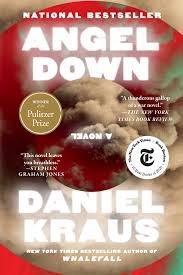
Often authors have one idea that interests them, and they hold on to it until another idea comes along and collides with the first one. It is then that they are ready to write. Such is the case with Kraus, who developed an interest in World War I while working on another writing project. When the idea of an angel came to him, he knew this confluence was worth thinking about. I had this novel on my TBR list, then the Pulitzer people gave it their award. Now I was really curious.
The story centers on Cyril Bagger, son of a preacher from the Midwest, Cyril rejects the straight and moral, becoming someone who works all the angles, a professional conman. He has mastered every type of gambling con, any game where the target puts their money down, Bagger will pick it up, every time. When his father sinks on the Lusitania, Bagger is picked up in the draft, sent to a unit along the front between France and Germany, near the Argonne Forest, the trenches of No Man’s Land. Here he serves the way he always has, not by going to fight at the front, but by doing anything to avoid it—digging latrines and graves, a busy business here. After a barrage from the Germans, his unit is on the move, when a terrible, relentless shrieking comes from No Man’s Land. Their commander leaves Bagger and four others behind to “take care of it”—meaning, euthanize the poor soldier out there shrieking.
The four others who are assigned this duty include: Arno, a fourteen-year-old orphan who snuck into the Army, he is the only one to like Bagger, clinging to him like a barnacle; Hugh Popkin, a mountain of a man, but with few brains, his solution to anything is using his fists; Vincent Goodspeed, who goes around taking anything he can from the dead, American or German, and selling his booty, making a lot of money from this conflict; and Ben Veck, an African American soldier picked up by this commander after his unit of blacks is mostly killed, meant to operate a flame thrower used in battle, a dangerous job. They are five cast-outs, five misfit soldiers, sent to No Man’s Land to kill a fellow soldier. After a ridiculous scene that leads to Bagger and Arno reaching the victim, they find a startling sight: an angel, with red dress and blue hooded cape, struck down by artillery, not injured, but caught in a nest of barbed wire, beaming a spotlight up to the heavens.
Each man will have his own unique way of responding to this extraordinary circumstance, each revealing his true character. This is where the meat of the story happens, how each handles himself, the others, and the angel. The setting is important, as World War I was still somewhat primitive, for example, using horses to move heavy artillery, but new technologies were used to fight—chemical gases, flame throwers, early machine guns, larger cannons, the first airplanes. It was war as meat grinder, with no honor, just throwing human beings into unsurvivable conditions. While the war lasted four years, the Americans joined the conflict for the last year. It was really just the precursor of World War II, which led to Korea, Vietnam, and on and on. Humanity can be viewed as trapped within a cycle of war, which became industrial and inhuman with World War I.
Viewing this change in humanity’s warfare, might God have sent a messenger, or even a protector, to stop the carnage? Kraus’s novel asks questions, with Bagger our representative to puzzle out the meaning of it all. One further element to this novel is the style Kraus employs—the story is told as one long sentence. It actually pulls the reader in quickly, as we feel the rush of events, everyone fighting to survive, most leaving their humanity aside until afterward. It is somewhat of an experimental novel, a speculative historical fiction story. It may not be everyone’s cup of tea—Kraus uses a cinematic style, painting with the full spectrum of color and detail, sparing no reader the grotesque details of the suffering and death by this type of warfare.
I’m glad I read this. It is an unusual, creative story, that asks interesting questions, and is worth your time. It is not meant to be a comfort read, but a serious, questioning one. Highly recommended, if you like your fiction to dig a bit deeper.