
The Lost Empire of Emanuel Nobel: Romanovs, Revolutionaries, and the Forgotten Titan Who Fueled the World, by Douglas Brunt
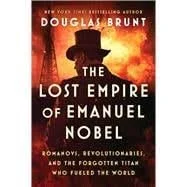
Brunt is making an interesting series about forgotten historical captains of industry of actual great significance. It is perplexing how certain individuals receive our attention in the limelight of history; while other, perhaps greater people are obscure to the point of vanishing from our view. Such was Rudolf Diesel in Brunt’s first nonfiction book about noteworthy men of the past (https://www.margueritereads.com/home/the-mysterious-case-of-rudolf-diesel-genius-power-and-deception-on-the-eve-of-world-war-i-by-douglas-brunt?rq=douglas%20brunt); and such is the object of his new book: Emanuel Nobel. We are all quite familiar with Alfred Nobel, chemist and inventor of dynamite, who bequeathed his fortune to establishing the Nobel prizes, perhaps the most highly regarded prizes in the world.
But who is his nephew, Emanuel, and why should we care? As a sidebar, it was Emanuel who settled family inheritance squabbles, then met with King Oscar II of Sweden to argue on behalf of his uncle’s wishes to establish the Nobel Prize. To understand Emanuel’s position of respect within the family Nobel, Brunt takes us back to Immanuel Nobel, father of Alfred, Ludwig, Robert, and Emil, and traces the family qualities and experiences that brought us to Emanuel’s significance.
The path leading from Sweden to Russia, the education, work ethic, social and business acumen, ability to read the bigger picture and read the room, the search for opportunity, and a little bit of luck—all of this led Immanuel, his sons Ludwig and Robert, then Ludwig’s son, Emanuel, to seeking their industrial fortunes in Russia. Beginning with machine development in support of the military, Ludwig was both a gifted engineer and businessman, who saw great opportunity in Russia. By working his way into the good graces of the Tsar and the military, Ludwig worked hard to build an innovative, responsive business that would be of great assistance to the military. Emanuel was Ludwig’s sidekick, following him everywhere, learning the business from the bottom up, he was prepared to be the next in line to grow the enterprise.
When Ludwig’s brother Robert, on a business trip for Ludwig to obtain wood for gun stocks, discovered the oil deposits in Baku, capital of Azerbaijan, a region in southern Russia in the Caucasus Mountains, it was the beginning of the real Nobel enterprise. Oil at this time was used only for illumination, but was highly valued. What first Ludwig, then mainly Emanuel, and their talented engineers did was invent and develop the means of extraction, refinement, and transport, as well as the infrastructure needed to perform all of these functions, effectively getting oil from the ground to the home, cleanly and efficiently. Emanuel heard of the Diesel engine, dispatched engineers to study it, then obtained the rights from Rudolf Diesel to manufacture diesel engines for many applications, making Russia the biggest adopter of diesel. He developed tanker ships, large and small, to transport large quantities of oil up Russia’s rivers, and later, over oceans. He developed train systems where none had previously run, and cars with tanks to distribute oil over land. Of equal importance was Emanuel’s treatment of workers, paying them well and reliably, building homes, schools, hospitals, all that was needed to improve their lives, creating great loyalty between worker and company. He paid his investors well, with year-on-year increases in dividends. Emanuel navigated the impossibly tricky political waters, first with Tsars, then with the newly established Duma, even trying to find a way to work with the Bolsheviks and Lenin, until it was time to escape Stalin for the West. Ultimately, Stalin took all Nobel assets in Russia, renaming it the Russian General Oil Corporation.
What I described in brief, Brunt makes into a thrilling drama: the excitement of the oil discovery, the hard work and tenacity of Emanuel to navigate every barrier to a remarkable achievement, the largest oil empire in the world, rivaling Standard Oil and Rockefeller; the rise of Lenin and Stalin, the murders of the Romanovs, World War I, the Russian Civil War, the establishment of Russian Communism, and the denouement, the final fate of Emanuel and his oil empire. The book reads more like an espionage thriller than history book, as you meet larger than life characters like Lenin and Stalin, learning historical events and their context along the way.
From the current point of view, it has a chilling aspect. The overthrow of the tsar was a welcome development, liberating the peasants, establishing freedom of assembly and speech, even the Duma, if its members were fairly elected representatives of the people. Lenin, Trotsky, and Stalin took advantage of the political instability, using coercion, lying propaganda, and shocking violence to force a takeover of an entire nation. There is a lesson there, for those willing to see it. Equally, there is a lesson in Emanuel’s work ethic, human decency, and ability to be useful, yet still canny. It is capitalism and economic freedom that permitted such rapid progress, pulling everyone involved up, from field worker to corporate leader. This was impossible under communism, motivating through fear. I highly recommend both of Brunt’s books, and we have yet to hear who the third innovative industrialist will be, in a projected third book of this series. Here is your recommended summer reading.